The Middle Corridor: A Road Between China and Europe, With Türkiye at the Gate
The Middle Corridor links China and Europe through Central Asia, the Caspian Sea, the South Caucasus and Türkiye. How it works, how long it takes, where it slows down, and what it means for your cargo.
October 26, 2026 · 5 min read
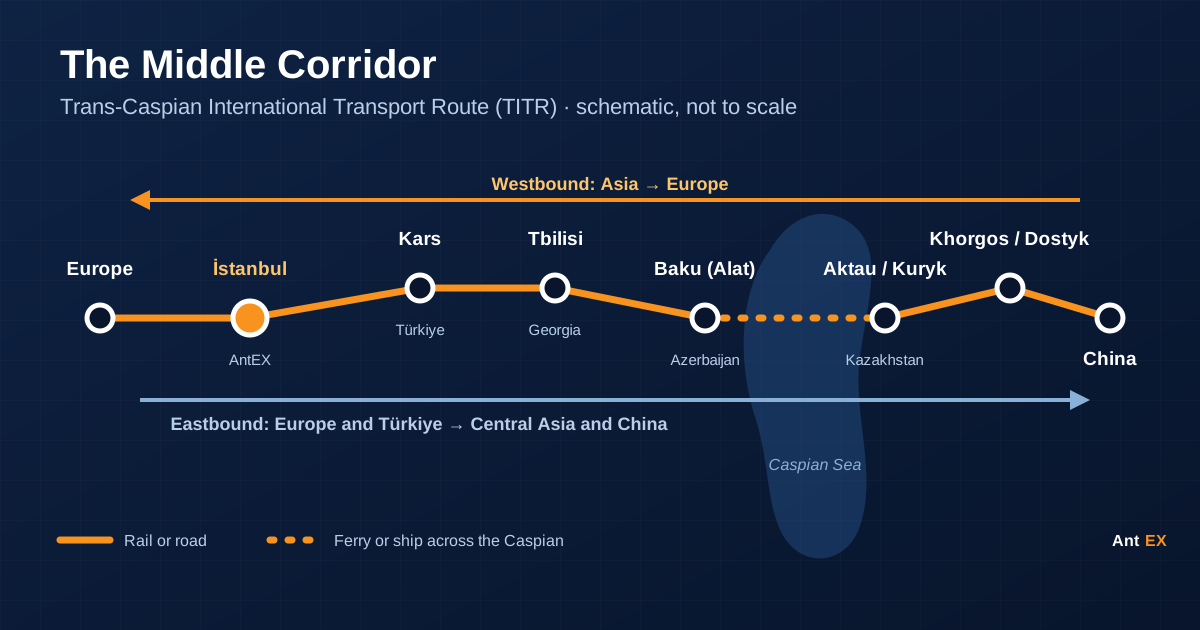
Between China and Europe there are three great roads. One runs north. One runs south, by sea, around Asia and through the Suez Canal. And one runs through the middle: across the steppes of Kazakhstan, over the Caspian Sea, through the Caucasus, and into Türkiye.
That middle road is called the Middle Corridor, or the Trans-Caspian International Transport Route (TITR). A few years ago it was a quiet line on the map. Today governments, railways and shippers talk about it every week.
Here is how it works, what is new in 2026, where it still slows down, and what it can mean for your cargo.
The route, step by step
The Middle Corridor is a multimodal route of roughly 4,000 km. Cargo changes mode several times:
- China → Kazakhstan by rail, through the border crossings at Khorgos or Dostyk.
- Across Kazakhstan by rail to the Caspian ports of Aktau or Kuryk.
- Across the Caspian Sea by ferry or ship to Baku (Alat) in Azerbaijan.
- Azerbaijan → Georgia → Türkiye by rail on the Baku–Tbilisi–Kars line, or by road.
- Across Türkiye to İstanbul, and on to Europe by rail or truck — or the other way round.
The road runs both ways. European and Turkish goods travel east on it, too.
How long does it take?
According to Kazakhstan Railways, a container from China to Europe on the Middle Corridor now takes 13–17 days, against 30–45 days by sea. Their target is a steady 10–12 days.
But "can" is not "always". The EBRD has noted that real transit times have ranged from 14 to 60 days, because of infrastructure gaps and the many hand-overs along the way. In August 2025, Turkish officials reported a freight train from China reaching Türkiye in 15 days; earlier trips often took more than 20, because of customs and Caspian weather.
In short: much faster than sea, much cheaper than air — but plan with a margin.
What changed in 2026
- Baku–Tbilisi–Kars at full capacity. The railway entered full-scale operation on 2 June 2026. Georgia reported that containers on the line in 2025 were nearly six times the year before.
- Regular trains from China to Türkiye. In July 2026, regular freight trains began running from Chongqing and Chengdu to Türkiye, with onward trips to Europe through İstanbul.
- Growing Caspian traffic. Sea freight on the Trans-Caspian route passed 4.5 million tonnes in the first seven months of 2026 — more than in the whole of 2025.
- Faster paperwork. Corridor countries approved a 2026 plan centred on digital documents and digital transit.
- New links ahead. Türkiye has started building the Kars–Iğdır–Dilucu railway, expected around the end of 2029. In İstanbul, a World Bank–backed project (INRAIL) aims to ease the rail bottleneck across the Bosphorus.
Where it still slows down
An honest guide must also show the bumps in the road:
- The Caspian crossing. Limited ships, busy ports and storms make this the main bottleneck. Falling water levels in the Caspian have already reduced ferry loads on the Baku–Kuryk route.
- Many borders, many hand-overs. Cargo crosses several customs zones and changes between rail and ship. Each step is a chance for delay.
- Limited capacity. The corridor is growing fast, but it still carries only a small share of China–Europe trade. Space can be tight in peak season.
- Different rail rules. East and west use different railway legal systems. Documents such as the CIM/SMGS consignment note help bridge them.
Who is it for?
The Middle Corridor fits best when:
- sea is too slow and air is too expensive;
- you ship to or from Central Asia and the Caucasus, where Türkiye is a natural partner;
- you want another route, so your supply chain does not depend on one road only;
- you are a Turkish exporter looking east — to Kazakhstan, Uzbekistan, Azerbaijan and beyond.
Türkiye's place on the road
Türkiye is where the Middle Corridor meets Europe and the Mediterranean. From the Georgian border at Kars, cargo can continue across Anatolia to İstanbul and into Europe, or turn south towards the ports of the Mediterranean.
For the Turkish market, the road also runs the other way: Turkish goods heading east to Central Asia, and Central Asian goods reaching the world through Türkiye.
How AntEX helps
AntEX works from İstanbul, at the western gate of the corridor, in both directions. We can help you:
- plan the route — rail, road or a mix — and compare it with sea or air;
- handle customs and transit in Türkiye, including bonded warehouses;
- consolidate smaller loads (LCL) in İstanbul, inbound and outbound;
- follow your cargo step by step, from the first border to the last.
Routes change, and so do conditions on the road. We look at each shipment on its own, and we tell you honestly what to expect.
Planning a shipment between Asia and Europe? Tell us where your cargo needs to go — we'll find the way. Request a quote
Sources
- Trend: Middle Corridor targets transit period reduction to 12 days — Kazakh official (25 September 2026)
- The Times of Central Asia: Kazakhstan Middle Corridor railway cuts detour, but Caspian bottlenecks remain (August–September 2026)
- The Times of Central Asia: Baku-Tbilisi-Kars railway boosts Kazakhstan's Middle Corridor role (June 2026)
- Caspian Post: Trans-Caspian corridor sees sharp rise in sea freight volumes (2026)
- Carnegie Endowment: The Middle Corridor transport route (29 April 2026)
- Aydınlık: First regular freight trains from China to Türkiye (July 2026, in Turkish)
- Trend: Kars–Dilucu railway expected by late 2029 (15 September 2026)
- The Times of Central Asia: World Bank INRAIL loan for Istanbul rail crossing (October 2026)
Please note: This article is general information, not legal, banking, or customs advice. Rules and practice can change, and they differ from country to country. Always check with your bank, your trading partners, and the authorities on your route before you change how you ship.
Lawful by nature
We move what matters — within the rules of international trade. Every shipment is checked with care, and we do not handle sanctioned goods.