Digital TIR (eTIR) Is Spreading Along the Middle Corridor: What It Means for Trucks Through Türkiye
Customs chiefs of the Turkic states backed the digital TIR system, eTIR. Where it already works, what is coming for Türkiye, and what shippers on the Middle Corridor should do now.
By AntEX Team · October 29, 2026 · 5 min read
A truck that leaves China or Central Asia for Europe can cross six or more borders. At each one, someone checks a document. For decades, that document has been a paper TIR Carnet.
The paper is now giving way to data. On 21 October 2026, the IRU reported that the customs chiefs of the Organization of Turkic States (OTS) had once again backed the digital version of TIR, called eTIR. Several corridors in Central Asia already use it, and Türkiye is preparing its own launch.
Here is what eTIR is, where it works today, and what it means if your goods move by road through Türkiye.
TIR and eTIR in plain words
TIR is a customs transit system based on a United Nations convention. A truck is sealed by customs at departure. At each border on the way, customs checks the seals and the carnet, but usually does not unload the cargo. A guarantee run by the IRU covers duties and taxes, so the carrier does not need to give a new one in every country.
The classic TIR Carnet is a booklet. Each border stamps a page and tears off a voucher.
eTIR keeps the same rules, the same seals and the same guarantee. What changes is the paperwork. The carrier sends the cargo and route data to customs before the truck leaves. Customs offices on the route then share that data electronically. When the truck arrives at a border, officers already have the information on screen.
What happened in Bishkek
The 12th Meeting of Heads of Customs Administrations of the OTS took place in Bishkek, Kyrgyzstan. The World Customs Organization (WCO) and the IRU took part, and UNECE was named as a partner in the work.
The customs leaders confirmed their support for expanding TIR and eTIR. Their stated aims were faster trade and transit, more secure borders, and simpler customs procedures based on international tools that already exist.
Two other points came up:
- Green lanes. The OTS supports TIR "green lanes": low-risk cargo moves through faster, so customs can spend more time on higher-risk loads. The IRU asked for green lanes to cover eTIR operations as well.
- Training. Uzbekistan's customs administration stressed that training must continue as countries move from paper to fully digital TIR. Both customs staff and transport operators need to know how to use the new systems.
Where eTIR already works, and what is coming for Türkiye
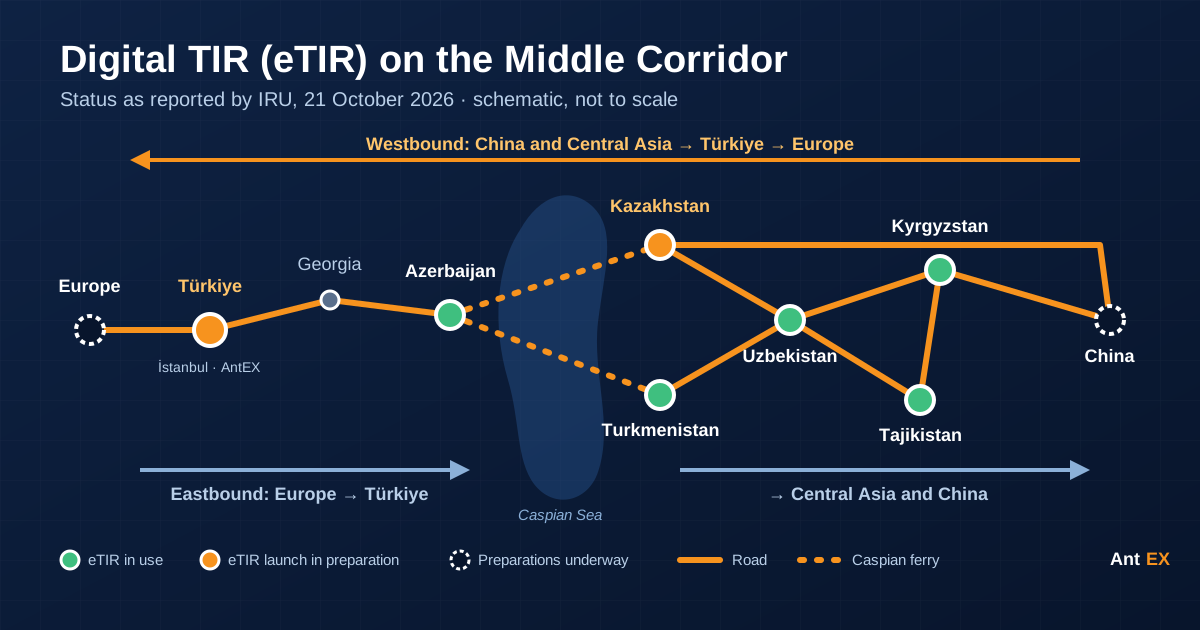
According to the IRU, eTIR is operational on several corridors that link Azerbaijan, Kyrgyzstan, Tajikistan, Turkmenistan and Uzbekistan. Kyrgyzstan and Tajikistan were the first in the region to open an operational eTIR corridor.
Next in line:
- Türkiye–Azerbaijan: Türkiye is preparing an eTIR launch on this corridor.
- Kazakhstan–Uzbekistan: Kazakhstan is preparing a launch here.
- Europe and China: preparations are underway, with the goal of digital transit corridors from Asia to Europe through the OTS region.
Put together, these pieces sit along the Middle Corridor: the route from China through Central Asia, across the Caspian Sea and the Caucasus, to Türkiye and Europe. The IRU item does not give a launch date for any of the planned corridors.
Why it matters for trucks and LCL cargo
What gets better
- Less paperwork. No carnet pages to fill in, stamp and tear off at each border. Fewer chances for a missing stamp or a typing error to hold a truck.
- Data before the truck. Customs can check the cargo data before the truck arrives, not while it waits at the gate.
- More predictable crossings. When the data is clean and known in advance, a border crossing depends less on paper checks. This matters most for LCL and groupage trucks, where one vehicle carries goods from many shippers and one bad document can hold everyone's cargo.
- Room for green lanes. If green lanes are extended to eTIR, low-risk loads with good data could move through with fewer checks.
What eTIR does not change
- Every country on the route must be connected. eTIR only works from end to end where all the customs offices on the route use it. Until then, the paper carnet is still used.
- Borders still have queues. Weather, traffic, inspections and working hours still affect crossings. eTIR removes paperwork, not every delay. We cannot say how much time it will save on a given route.
- Bad data is still bad data. A wrong description or HS code is now sent faster, but it is still wrong.
What shippers should do now
- Ask your carrier or forwarder if they are eTIR-ready. Can they send eTIR declarations? Are they ready for the Türkiye–Azerbaijan corridor when it opens?
- Keep your cargo data accurate. Goods description, HS code, weight, number of packages and the commercial invoice must match. With eTIR, this data reaches customs before the truck does.
- Watch for the Türkiye–Azerbaijan launch. For goods moving between Türkiye and the Caucasus or Central Asia, this is the corridor that brings eTIR to our part of the route.
- Keep a paper option. Until every country on your route is connected, your carrier may still need a classic TIR Carnet for some legs.
eTIR does not change where your cargo goes, only how its papers travel. At AntEX we follow these changes closely, so you can move with them when the time is right.
Have questions about the documents for your next shipment? Tell us where your cargo needs to go — we’ll find the way. Request a quote
Sources
- IRU: Turkic states reinforce support for digital TIR (21 October 2026)
Please note: This article is general information, not legal, banking, or customs advice. Rules and practice can change, and they differ from country to country. Always check with your bank, your trading partners, and the authorities on your route before you change how you ship.
Lawful by nature
We move what matters — within the rules of international trade. Every shipment is checked with care, and we do not handle sanctioned goods.