The Price Behind the Price: Hidden Costs in International Shipping
Your freight quote is only part of the bill. THC, BAF, demurrage, detention, storage and more — where each cost appears, who pays under each Incoterm, and how to ask the right questions before you ship.
October 26, 2026 · 5 min read
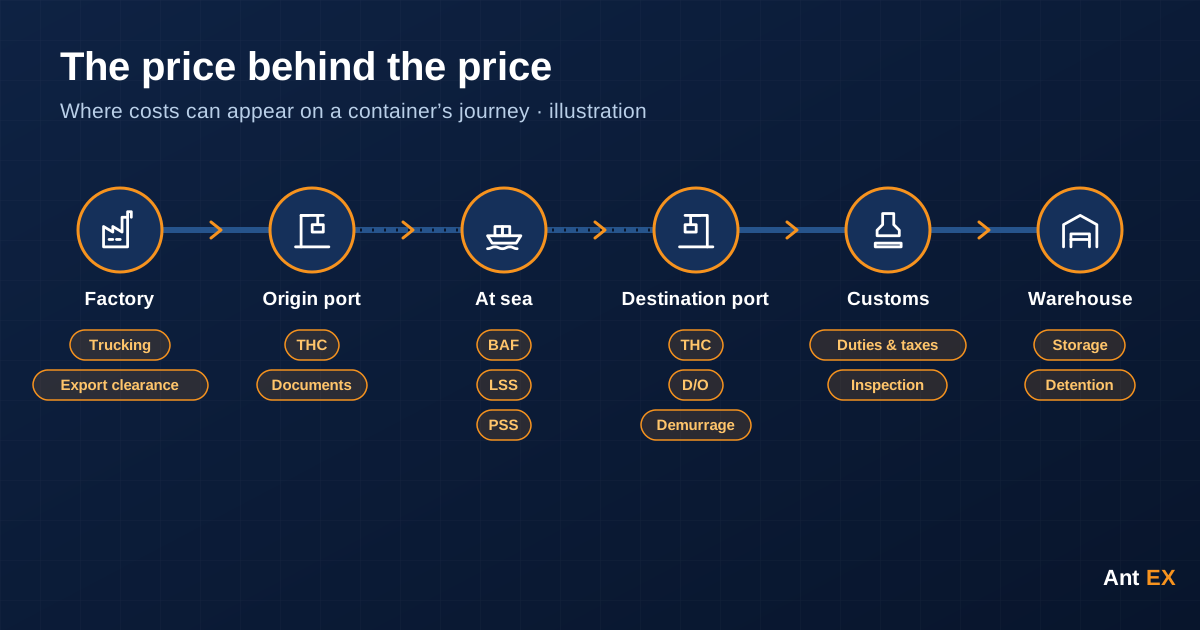
A freight quote is a little like the tip of an iceberg. The number you see is real, but most of the weight sits below the waterline: charges that appear at the port, at customs, or days later, when a container waits longer than planned.
None of these costs are secret. They are simply easy to miss if nobody puts them on the table at the start. This guide walks along the journey of one shipment and shows where each cost appears, who usually pays it, and which questions save money before anything moves.
Why the first quote is rarely the final bill
Most quotes cover the main ride: the sea, road or air leg. Around that ride sit many smaller services — handling at the terminal, paperwork, fuel adjustments, waiting time — and each may be billed by a different company: the shipping line, the terminal, the customs broker, the trucker.
When these pieces are not agreed in advance, they arrive one invoice at a time. The goal is not to avoid them (many cannot be avoided) but to see them before you sign.
Stop 1: At origin
- Pick-up and inland transport from the factory to the port or terminal.
- Export customs clearance and the fee of the customs broker.
- Origin THC (terminal handling charge): the terminal's fee for moving the container through the port and onto the ship.
- Documentation fees: issuing the bill of lading, VGM submission, seal fees.
- LCL only: consolidation (CFS) charges for packing several shippers' cargo into one container.
Stop 2: The main ride
The base freight is only the starting point. Shipping lines add surcharges that move with the market:
- BAF — bunker (fuel) adjustment, which changes with fuel prices.
- LSS — low-sulphur fuel surcharge, linked to cleaner-fuel rules at sea.
- CAF — currency adjustment, when exchange rates move.
- PSS — peak season surcharge, added when demand is high.
- GRI — general rate increase, announced by carriers for a future date.
- ISPS — a security charge linked to port security rules.
Because these change over time, ask whether your quote is "all-in" and until which date it is valid. A quote valid for a week can look very different from one valid for a month.
Stop 3: At destination
- Destination THC: the mirror of origin THC, charged at the port of discharge.
- D/O (delivery order) fee: the carrier's or agent's fee for releasing the cargo to the consignee.
- Import customs clearance, duties and taxes. These are often the largest "hidden" part of the bill, and they are the heart of the landed cost.
- Inspections: if customs selects the container for physical inspection, there can be extra handling and waiting costs.
- LCL only: deconsolidation (CFS) charges at the destination warehouse.
- Final delivery from the port to your door.
Stop 4: When time becomes money
This is where small delays turn into large bills.
- Free time is the number of days you can use the container or the terminal without extra charges.
- Demurrage starts when a full container stays inside the port after free time ends.
- Detention starts when the container is outside the port (at your warehouse, for example) and is not returned on time.
- Storage is charged by the terminal or warehouse itself, separately from the shipping line.
These charges are counted per container, per day, and the daily rate often rises the longer the delay lasts. Missing documents, a late customs declaration or a full warehouse are the usual causes. Many cargo insurance policies do not cover them, because they are a cost of time, not damage.
Who pays what? The role of Incoterms
The Incoterms agreed in the sales contract decide where the seller's costs end and the buyer's begin. Incoterms 2020 is still the version in use; the ICC usually revises the rules about once a decade.
| Incoterm | Origin costs (export clearance, origin THC) | Main freight | Destination THC and import clearance | Duties and taxes |
|---|---|---|---|---|
| EXW | Buyer | Buyer | Buyer | Buyer |
| FCA / FOB | Seller | Buyer | Buyer | Buyer |
| CIF | Seller | Seller | Buyer | Buyer |
| DAP | Seller | Seller | Seller pays transport to the named place; import clearance is the buyer's | Buyer |
| DDP | Seller | Seller | Seller | Seller |
This table is a simplified guide. Real contracts and carrier practice can shift some items, so always read what your own contract says.
A common surprise: under CIF, a buyer may think "freight is paid", then receive a separate invoice for destination THC and the D/O fee at the port. Under CIF those are normally the buyer's costs.
Seven questions to ask before you ship
- Is this quote all-in, or are surcharges (BAF, LSS, PSS) added later? Until when is it valid?
- Are origin and destination THC included?
- How many days of free time do I get for demurrage and for detention — and can I ask for more?
- Who pays the D/O fee and documentation fees at destination?
- Which Incoterm is in the sales contract, and does every party read it the same way?
- Are customs clearance, duties and taxes estimated in the offer?
- If my cargo is selected for inspection or must wait, what are the daily costs?
The calm way to ship
Hidden costs are not traps; they are simply parts of the journey that nobody named. When every stop is listed before the cargo moves, the final bill holds no surprises, and planning becomes a straight road instead of a winding one.
Not sure what your shipment will really cost? Send us the route and the cargo — we'll lay out every stop before it moves. Request a quote
Sources
- GoFreight: Terminal Handling Charges (THC) Explained 2026
- Legal Clarity: Terminal Handling Charges — What They Cover and Who Pays
- Flexport: Demurrage and Detention — Why It Pays to Know Your Fees
- GoComet: Demurrage Fees Explained (demurrage, detention, storage, per diem)
- HFW: ICC Incoterms 2020 — Commentary
Please note: This article is general information, not legal, financial, or customs advice. Charges, their names, and who pays them differ by carrier, port, and contract. Always check your own quote and sales contract before you ship.
Lawful by nature
We move what matters — within the rules of international trade. Every shipment is checked with care, and we do not handle sanctioned goods.